



By Mike Hirsh, Club Chairman
Important dates for 2026
2026 is the 75th anniversary of the founding of the Wimborne and District Angling Club. The membership books for the forthcoming year identify the fact on the front cover. The Club’s Committee wish you all well for the year ahead and we will do our best to ensure the Club’s future remains secure and we continue to manage, and where possible, improve the portfolio of waters so that members have the continuing opportunity to enjoy their fishing.
The Game Section Annual Meeting will be on Tuesday 10th of March 2026 and will take place at Corfe Mullen’s Royal British Legion Club. The meeting will commence at 19.30 and entry will be on production of your current Membership Book.
The Annual General Meeting for the Club will then take place on Tuesday 24th March also at Corfe Mullen’s Royal British Legion Club. This meeting will also commence at 19.30 and entry will be on production of your current Membership Book.
The Committee is pleased to let you know that the Club has secured winter fishing at Whitemoor Lakes. The new membership book will carry details and a map and will advise:
“This day ticket commercial fishery is located south of Holt Heath and north-east of the Broomhill Crossroads.
Directions:
• Coming from Wimborne, travel along Colehill Lane northeast through Broomhill to the crossroads with Hart’s Lane and Pilford Heath Road. Continue straight over and the fishery is in approximately 0.6 mile on the right.
• From the north, travelling on the Holt Road, turn south at the staggered crossroads at the west edge of Holt Heath signposted Broomhill, Colehill and Wimborne Minster. The fishery is in approximately 0.8mile and is on the left.
• The entrance is well signed with a setback wooden fence and gate.
The Club has an arrangement which allows any Club member, with a fishing membership, to fish for free in the winter months between the 1st October and the 31st March. It also enables an angler to fish the night ticket offered for half price during this period. [As the Club has just agreed this arrangement the first time it will be available at no cost to WDAC members is on the 1st January 2026].
Facilities:
• The site has five lakes, and all are well stocked. Each lake has associated parking close to it. The lakes contain a wide variety of coarse fish. [Please visit the Fishery’s website for further details].
• As there are toilet facilities, it is on the level with constructed platforms and has good parking facilities it is capable of providing fishing for the less able.
The daylight hours during which the fishery is open varies and anglers will need to check accordingly.
Fishery Rules:
The rules that apply are those of the Fishery, please see the Whitemoor Lakes website and the information on site. There are no different WDAC rules, but you will be required to show your membership book on arrival. The main Fishery rules are:
• No keepnets.
• Unhooking mats must be used.
• Barbless hooks only.
• No fixed rigs.
• Fish from the platforms on marked swims only.
• Dogs must be kept on a short leash at all times.
• No moving between lakes to fish.
• Members will be unable to use a lake if there is a match being fished on it.
• Do not leave any rubbish on the bank.”
And this is the new map which illustrates this water which you will find in the 2026 Membership Book.
December 2025
By Mike Hirsh, Club Chairman
Whitemoor Lakes
By Mike Hirsh, Club Chairman
The Price of Trout tickets
As those members who receive the monthly Game Secretary email from Paul Baker will know, the price of trout tickets was to go up on 1st January 2026. However, the price increase is currently deferred until at least the end of February. The reasoning is that the Club has had to secure a delivery of fish to Winterborne Zelston which are, on average, a smaller size than normal and from a new supplier.
Please will trout fishermen give feedback to Paul on their views about this stocking in terms of quality. It may determine where we buy fish in the future.
By Mike Hirsh, Club Chairman
What has the Club been doing
Running an Angling Club is meshing reality with hopes and aspirations. The Club’s Committee continues to meet on a monthly basis and WhatsApps between times so there is almost daily contact. Club activity remains a mix of regular events and maintenance, and then additional projects to move the Club forward and keep invested in our waters and to also invest in the members of the team that manages them. 2025 has been a good year, it being easier to get bankside without the super-abundance of water we endured in 2024. It has also been a good training year for some members of the Committee.
The Club’s Committee had been considering how best to dredge Julia’s at Edmondsham’s Pinnock Lakes for a couple years. The Committee, in the end, decided on a wet dredge and then in 2024 the banks remained so wet it could not be done safely. In June 2025 the lakes were closed for a week whilst a long-necked, yellow machine worked around the lake digging out silt, which was taken away by tipper truck and left carefully behind a straw bale dam, in the dip close to the entrance. My role in this work was to keep out over curious residents and members and manage displaced swan mussels. Hugh Miles, who also helped with the mussels, has done an excellent blog of the week as part of his online article titled ‘Creating Magic,’ about both lakes and his pictures in the article of Julia’s with white clouds reflecting in the water, and a crucian carp have been borrowed for two of the pictures used in the new Club Membership book’s inside cover. I will, therefore, not go on about it at length and you can go and find Hugh’s beautiful work.
My main concern was how the fish would react to the large yellow arm and bucket swirling about in the water and the arising movement of mud. On the first morning there was the temporary cessation of activity after about forty minutes to do something mechanical to the tipper truck. To my relief, within five minutes of the bucket staying still, bubbles rose right on top of the working area as carp swirled about feeding and bream nosed in too. The disturbance to the water had created a feeding opportunity and the fish were enjoying the moment. It was very similar, in many ways, to the behaviour of trout at Winterborne Zelston when the big Neptune rake is being hauled by the winch. The lake bottom gets stirred up and the trout cruise behind the rake picking up the invertebrates and these fish too can be seen taking advantage of the opportunity.
The Club discovered that dredging work is like buses, as after a long absence, suddenly two come along together. Having got Julia’s underway, the discussions that Club officers had been having with our landlord at Rawlsbury, and mentioned in the May newsletter, came to fruition and the water in Chapmans, the largest lake in the complex, was drained away. As this was a dry dig the equipment was different, but also a much greater volume of silt was removed reflecting the size of the project following years of siltation. The work has made a radical difference, restoring the lake to that which I remember from over twenty years ago.
Rawlsbury, of all the Club waters gets my vote as the most beautiful and tranquil.
My main concern about Rawlsbury this coming year will be how much weed is going to grow in Chapmans now the lakebed has a new face with exposed residual nitrates and phosphates from bye-gone farming practices. We will see.
The walkway in the southeast corner of the lake at Winterborne Zelston needed new posts to support it on the lake side. The eight existing posts, some two metres in length were being destroyed over the section which came in contact with the water on a temporary basis associated with the seasonal changes in lake level. The slightly softer wood appeared to be being eaten by snails. It was agreed that re-constituted plastic posts would be the best solution.
Bob, who takes control of the game section working parties, devised a way of lifting a post out of the silty soil and leaving the hole in which a new post could be dropped. Two car jacks were needed to lift a post, and a further larger jack was needed under the walkway to keep it in position when a post was being removed. Once there was a hole Greg dropped a new post in from above, standing on the walkway, and then used his spirit level to ensure it was vertical before the new post was drilled and connected with bolts back to the existing structure. Quick drying post cement was then used to ensure permanence. It was a brilliant piece of work thought through by Bob and executed beautifully. The dry summer certainly helped this project as the ground from which the posts were being removed was firm and the low water table had left the area dried out.
Not all the work by the Club has been physical and on a bank. The Club has negotiated a couple of important lease renewals. Committee training has also remained important. Steve Neale and Aron Bridges have both been through Level 2 coaching training with the Angling Trust to enable them to work with novice fishermen on Club initiatives getting members of the public to become anglers or anglers returning to fish after a gap of inactivity. The Club also booked three of the Committee on a Fisheries Management Workshop run at Mudford Village Hall 6/7th December by the EA in conjunction with the Institute of Fisheries Management. I went on a very similar course about eight years ago with other Committee members, and the information picked up then has been really useful since. These courses are free, but it does require those taking part to give up their weekend to attend.
Returning to the routine, most recently, on the 20th December bailiffs had a working party at Alder Hills clearing up and cutting back. Whilst at Edmondsham five volunteers strung Medley’s with bailer twine to try to prevent cormorants getting in to feed on the small fish, particularly the crucian carp which are pure bred and came originally from the EA Calverton Fish Farm. The stringing across the lake still enables anglers to fish off the platforms by sliding the strings to one side and then moving them back afterwards. Indeed, some strings are tied off with a bowline to provide a loop to facilitate this.
So next year there are plans to build a new disabled access double platform at Packhorse near the new car park, and to also build a proper fishermen’s hut and store at Winterborne Zelston. However, the routine events of clearing weed and cutting banks will go on as they do each year.
By Mike Hirsh, Club Chairman
Cormorants
I have no hesitation in putting in a reminder about the need to log cormorant sightings and to do so via the website.
If you go on to the Club’s website and scroll down the menu, you will find the list of ‘pages’ and the one immediately above ‘Contact’ is ‘Cormorant Watch.’(Please see below).
If you are out on our waters and see a cormorant(s) it is an immense help if you can go to this page on the website and record the requested information. If you complete the form and submit it, I will get these details via the Secretary’s email address and add it to the evidence I need to send to Natural England, when I submit the Club’s licence to deter and if necessary shoot these birds that are otherwise protected.

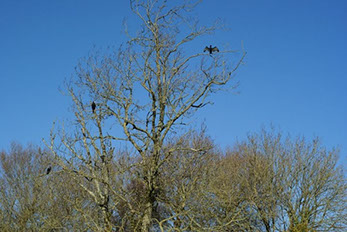
Please go to this page and report your sighting
Photo courtesy of Brian Heap
If you own a 12 bore and would like to shoot, normally on winter mornings just after dawn, at Edmondsham, Kingsbridge or Winterborne Zelston please let me know. I may be able to put you on the Club’s licence in due course.
By Mike Hirsh, Club Chairman
Drought
In 2024 the weather was wet. In the end of the year newsletter, I quoted the EA Water Situation Report for the 12 months running up to November 2024 as the fifth wettest since records began in 1871, and the south-west received 1417 mm of rain (or for those of a certain age 4 feet 7.75 inches). Having gone from excessively wet it is perhaps not surprising that the south-west this year found itself in a drought situation.
Part of the problem was the dry sunny Spring of 2025. But that sunny weather continued, and indeed, in mid-December the Met Office announced that 2025 has been the sunniest year in the UK since records began in 1910. However, it was not just sunny, and the south-west, particularly the coastal belt, experienced cloudy days where the rain fell elsewhere. There was a dry first half of October when some steady, heavy rain might have been a perfect tonic for our local rivers and the aquifer. In terms of steady rain falling in a way that would really help groundwater, there was not enough during the Autumn with rain events often being intense and short- lived leading to surface water running away too quickly to soak into the ground.
The most recent 12 months (December 2024 to November 2025) was at only 89% of the long-term average rainfall with 972mm of rain.
The River Stour for a large part of October was ‘below normal’ (which statistically means it is in a band of 15% immediately below ‘normal’ which the River is for 44% of the time). Of course, the Stour and its sister rivers in the area needed a good scouring to move the summer debris and silt deposits arising from low flow. That has finally happened with the December rain events culminating in the solid spell of wet on the 18th, which caused flooding on the R Stour.
As, for much of the time in summer and autumn there has been no real flow in the rivers for fishermen to rely on, fishing has been very difficult. Further, the fish are often not where they should be due to stretches being shallower. Sea-trout and salmon could not arrive until river flows increased, as they could not navigate physical obstructions that bar the way in low flows. And in any event these fish wait in the estuaries for the scent of rainwater to trigger their running. Lakes have not been filling in the same way and have been lower than in a more normal autumn.
On WDAC working parties and projects there were gains and losses in 2025. At Winterborne Zelston the replacement of new posts to support the existing walkway structure was carried out in the dry. In 2024 this work could not have been achieved at all as the bottom of the old posts remained submerged. At Edmondsham the wet dredge of Julia’s went ahead, and more was done than initially had been considered likely, due to the ground being baked hard enough to carry heavy machinery. Conversely, I was helping with some hand digging on the dam at Rawlsbury to re-instate waterside seating at the beginning of October, and the ground was so dry and baked that it rang when trying to drive in the uprights after a pilot hole had been dug. It was harder work than expected as there had been no penetration of rain into the sub-soil.
At Winterborne Zelston, last year in the first week of October, the lake was full, water had started to flow over the weir outflow; and the Winterborne in the Village was running. Club trout anglers enjoyed wonderful Autumn sport. This year the lake at the same time was but a large puddle, and the Winterborne was bone dry.
The boreholes taking water from the aquifer are not helping and of course there is a delay between rain falling and the aquifer filling. It is fortunate that trout anglers have had a rejuvenated Chapman’s lake at Rawlsbury which was open for six weeks longer than usual to reflect the loss of time in the summer, when this lake was also being dredged.
Whether you believe in global warming or not does not help a Club like ours run fisheries in the short term. The Committee continues to manage what we find and plan for the future as best we can. For example, a contractor has just cleared the two main ditches in the north part of the Kingsbridge complex. That is in part a response to the need to manage the heavier downpours that are now so common and also to try to keep this fishery in good condition as one of these ditches takes water from Tranquil that in turn takes the overflow from Packhorse (and yes these ditches are the Club’s responsibility under the terms of the lease).
By Mike Hirsh, Club Chairman
The Smaller of the Two Ponds at Creekmoor
Regular readers will recall an article in the May 2025 newsletter that reported about twenty-five carp deaths at the smaller of the two ponds at Creekmoor. Carp were seen in a lethargic state from a cold spell in early February and most of those in that condition did not survive. The Environment Agency had investigated and organised a biopsy on a freshly killed carp to try to ascertain what was going on. In the end no obvious cause of the deaths could be found and it has remained unresolved. With the warmer weather carp were seen behaving perfectly normally, basking in the sunshine. Bailiffs tried to assess the numbers of those appearing to be behaving normally and they clearly outnumbered those found dead and dying. Spawning took place at the pond with the first warm weather. There has been no further evidence of disease since.
There are a generation of tiddler carp that have spent the summer growing, and the lake was also stocked with some fingerling tench last December too; so the Club remains optimistic about the stock of fish here. We will of course be monitoring the situation as you would expect.
By Mike Hirsh, Club Chairman
Classroom Days
One of the joys of being the Chairman of an Angling Club is that most days really are ‘school’ days. There is always something new to learn.
I will give you two examples.
First, last June I spent a few hours researching the life cycle of freshwater mussels and in particular swan mussels. I have known for a long time that the Club has swan mussels in some of its waters, but I had never really wondered about how they breed and how long they survive. I did know that they were filter feeders potentially helping to clean lakes and that they add to the biodiversity of waters but not much more than that. My interest was spurred by the knowledge that the following month the wet dredging of Julia’s lake, one of the two Pinnock Lakes on the Edmondsham Estate, was going to be undertaken and I wanted to make an effort to save any mussels dug up as a bye-product, if it was worth the effort.
Female swan mussels retain their fertilised eggs through the winter after the males have wafted sperm across them which is drawn in through the females’ syphons. The eggs hatch into larvae, called glochidia, in the spring which are released to float freely in the water. The glochidia then hitch a ride on a fish and, for a short while become a parasite, feeding on the fish slime and growing quite fast into a very small mussel. After around a month these tiny mussels drop off. Swan mussels are not that particular about hosts, and it appears most lake fish species are acceptable. Part of the value in being a passenger on a fish is that the mussel will get carried away, as like as not, to somewhere away from the parents.
They are apparently likely to live for at least twelve years, and this may be checked by counting the distinctive growth rings, rather like counting rings in tree trunk cross-sections. Certainly, some of the mussels I found, that were in the dredged material, were likely both due to their size and rings to be considerably older.
It made me wonder - did the mussels in Julia’s come from fish stocked by the Club? Did they float in as glochidia with the water taken the River Crane? Did somebody just secretly stock some? I have no answers to these questions, but in turn it raises some interesting concerns about biosecurity too!
What I could also not find was any information on how far swan mussels travel on lake beds. Do they move looking for the ideal location and what is that location, and do they go off looking for other mussels? Research in streams in the USA tends to suggest that baby mussels just settle and stay in the same place. This also, therefore, tends to suggest that in still water lakes, if the immature mussels drop off their fish hosts in the wrong place they will perish.
Mussels can be major water engineers, taking fine floating particles from water, that often make it cloudy, and filtering this out to feed. The excrement in turn is likely to be attractive to small fish and invertebrates to feed on.
It was decided to try and save as many swan mussels as we could, as they were obviously beneficial to the biodiversity of the lake. So, a couple of weeks after reading about them I became the self-appointed keeper of found mussels at Julia’s during the dredge. A number of volunteers joined in to help save them as did those directly involved in the dredging. We saved well over a hundred which I kept in two keepnets until they could be returned to the lake. What also became clear during the dredging was that the west side of the lake, in certain locations, had real concentrations of the mussels and these appeared to be where sunlight hit the water for most of the year. The east side of the lake adjacent to the River Crane, had very few.
I also found one goose mussel – where did that come from? And before anybody starts going on about it on social media it did not come from the Canada geese! (Goose mussels are similar but smaller than swan mussels).
By way of my second example, I have also found out recently that alder trees have a ‘die back’ disease like ash trees. However, whereas ash die back has received national media attention, I do not recall seeing much about Phytophthora alni, which causes root rot and bark lesions, and I certainly do not remember seeing anything about its spread. It was first discovered in this country in 1993, and Forestry Research (the research related arm of the Forestry Commission) advises that about a third of the UK’s alder trees may be affected. This disease is going to reshape the landscape adjacent to water bodies and will have an impact on our local waters. It is caused by an algae-like organism and is waterborne. It is also now widespread in Europe, from which it is believed it came in the first place, travelling on imported nursery stock.
In the Club’s forward plan is an expenditure allocation for some tree work to be carried out around both Widgeon and Wellington. In a future Newsletter there is likely to be a briefing about this work that may lead to some temporary disruption at Kingsbridge. However, as the felling licence is yet to be submitted, it is premature to explain these works in more detail. It may well be that some of the alders do have Phytophthora alni.
By Mike Hirsh, Club Chairman
Fish Stocking
Stocking coarse fish from an outside source is not an ideal action for any Angling Club to take, it is preferable to have and encourage self-sustaining stock breeding naturally. Introducing new fish opens the existing stock to the dangers of biosecurity breaches, and it also may also introduce the new fish to dangers of infection carried by the existing stock. Sometimes new fish do not thrive, and it may just be that for some reason, beyond our understanding, they are not at ease in their new home.
There are, nevertheless, a number of drivers that tilt the balance in favour of stocking. This year the Club has stocked some carp, in the Spring, to boost stocks where we are aware of predation, and also some of the same consignment went to Crooked Willow. These fish were from a trusted supplier the Club uses regularly.
More interestingly, in some respects, the Club has introduced chub into both Packhorse at Kingsbridge and at Edmonsham this year to act as a control to reduce the numbers of small fry. As chub feed throughout the year these fish will also provide an opportunity for winter fishing. Chub do not breed in sill water so they will not cause the problems, frequently met with predators such as perch or pike, where populations can get out of control in just a few generations. As you would expect, the introduced chub are not large, just big enough!
Last, the Club received a top up of roach, rudd and tench into Julia’s from the Environment Agency’s National Fish Farm at Calverton just before Christmas. These young fish are part of an agreed strategy being delivered by the Agency, the first batch of which was received last year. Calverton fish are free to Clubs and similar end users and are, in essence, paid for out of rod licence monies.
By Mike Hirsh, Club Chairman
Committee Vacancies and help needed looking after waters.
The Club is in good health. Membership numbers have seen an increase this year. The profile of the membership is also in good heart with a spread of ages. WDAC is not an old mans Club! However, its Committee always needs fresh blood, and it would be excellent if the vacancies below could be filled without delay.
The Club inevitably has a turnover of Committee members, and we can also always do with help on working parties too. I am pleased the Club’s Committee has been relatively stable through much of the last ten years. Nevertheless, change is inevitable.
The Committee has recently been considering media communications and the Club’s website. In part this has been against the background of the resignation of James Nash as Media Officer. James, who is stepping down for personal reasons, has been fundamental in providing the Club’s website and keeping it running. He has also made a hugely positive contribution to getting anglers engaging with the Club.
Personally, I will miss James greatly as he has provided a terrific service, often unsung and in the background; and yet has always been there for me to use as a sounding board in an area where my skills are less than perfect!
James’s retirement from the post is going to be gradual, as he is moving the website to a more user-friendly platform and so we will need a replacement who is familiar with working with Squarespace which is the current preferred option. James intends to hand the new website over in a final form, but inevitably it will change its information often responding to events and highlighting initiatives. Eventually this post will be one of two similar posts as the Club moves gradually to ever greater use of computerisation. The Club needs new blood with the right skills to help in this area and, given James’s gradual departure it will provide an opportunity for a seamless transition.
The Club also needs a Welfare officer. The post is currently a job share, but there is the need for somebody to concentrate on the youth side of the Club, including the education of Minor Members (under 15 years of age) of which the Club now has over two hundred and fifty. The Club will assist with training opportunities through the Angling Trust for the successful individual. This work will involve a regular commitment to some Saturday voluntary working to meet the needs of the post.
In addition to these Committee posts the Club is always interested in obtaining the services, for those members who have practical skill sets. If you have an interest in a particular water and/or have skills that would help keep banks and platforms in good order in terms of practical maintenance then the Club is always interested. Greg Steele, who is on the Committee, has been reviewing the maintenance on Club waters and is undertaking a schedule of works at Kingsbridge and at Edmondsham. He could really do with some help.
If you are interested in working in either of the above Committee posts or can simply give some hours to assist with practical bankside related work please email the Club Secretary explaining how you can help. We will be delighted to follow up your contact.
.jpg?crc=4064544067)
NEWS BY MONTH
DECEMBER 2025 NEWS
MAY 2025 NEWS
FEBRUARY 2025 NEWS AGM
DECEMBER 2024 NEWS
MAY 2024 NEWS
MARCH 2024 NEWS AGM
DECEMBER 2023 NEWS
MAY 2023 NEWS
MARCH 2023 NEWS AGM
FEBRUARY 2023 NEWS
DECEMBER 2022 NEWS
SOCIAL AND CONTACT

SUBSCRIBE TO OUR NEWSLETTER


TERMS AND CONDITIONS
COPYRIGHT WDAC 2024

ANGLING TRUST - SAFEGUARDING CHILDREN AND YOUNG PEOPLE IN ANGLING
DATA PROTECTION REGULATIONS STATEMENT